Wednesday, April 23, 2014

Nimes:  Walking Tour with TZ and MK

We took a day-long walk through the old central part of Nimes with our visitors, TZ and MK.  Highlights = the Roman Arena, Imperial Temple (Maison Carree), and the Tour Magna (1st-century Roman watchtower with beautiful gardens).

Picture album.

Les Baux-en-Provence and La Carmargue

The  ruined castle and the medieval village of Les Baux are situated on a very steep, isolated island of rock high above the valley floor in the Alpilles. The region is famous for the discovery of Bauxite in 1822 and for its fine vineyards. Once a proud fief of its own, it is now a picturesque tourist destination and a favorite with hardy bikers.  We visited with TZ and MK. The village also has a small museum of "santons," locally carved figures in the costumes and activities of local peasants thatnwere used in rural households after Nativity scenes in churches were forbidden after the Revolution.

The Carmargue
is the romatic heart of Provence, a vast, marshy delta region bordering the Mediterranean at the mouth of the Rhone.  It is famous for the walled crusader city founded in the early 1200s by Louis IX (St Louis) from which he launched his two crusades, but also for its rice fields, its stocky white horses, its herds of black bulls headed for the arenas, and its seafood.  Much of the area is a regional natural park, which is where we visited a huge bird sanctuary filled with flamingos, herons, storks, etc.

Click for a few pictures.

A Walk through Nimes

Susie and I take a walk through part of the old inner city of Nimes, with stops at the Maison Carree (Roman Temple from 1 BCE), the neighboring Museum of Contemporary Art / Public Library, and the Museum of the City of Nimes (devoted mainly to the city's past history as a center for weaving denim (de Nimes) and silk.

Picture album.

Three Holy Sites:  Montmajour, St-Roman, St-Laurent

Visits to three early religious sites in our area.  The Abbey of Montajour was a Benedictine foundation from the 10th century, situated high on a limestone hill overlooking the marshes and fields (often painted by Van Gogh) above the city of Arles. There is a lower church (crypt) cut into the rock, a 12th-century upper church and cloister. Also a fascinating necropolis of graves for the monks that were cut directly into the rock.

The Abbey of St-Roman is on a huge cliff above Beaucaire with an unbelievable view of the Rhone valley. The abbey is entirely underground, cut out of the rock by "troglodyte" hermits who lived in tiny underground cells from as early as the 5th century.

St-Laurent
is an 11th-century windowless chapel by the roadside.  No entrance for visitors.

Click here for a few pictures.

Monday, April 14, 2014

Aigues-Mortes:  Market Day and Lunch with Friends

On Sunday, we drove down to Aigues-Mortes a second time (see preceding blog post).  Today was warm and sunny (like almost every day here), so we enjoyed strolling through the extensive outdoor market and picking up a few things for our meals, including luscious local strawberries.

We spent the afternoon with David Zarka and his family, enjoying a long, slow, leisurely, and absolutely delicious lunch. Here is the course by course menu:  1. An aperitif of cold pastis, the favorite summer drink in Provence, with appetizers, 2. delicious local oysters on the half shell, 3. a salad with homemade anchovy dressing and topped with baked mussels covered with melted cheese, 4. a cold salad-like main dish of potatoes and octopus, 5. a cheese tray with three different varieties to try, 6. a "fougasse," a special flat cake made with orange blossoms, 7. coffee.  Oh, and bread and wine throughout the meal.  We had to leave a little early to catch a concert back in Nimes -- after only 4 1/2 hours at the table.  The conversation in fractured French was lively and too much fun.  Thanks David and Patrice and Family!

Pictures:

Aigues-Mortes:  The Fortified City of St. Louis

The town of Aigues-Mortes ("Dead Water") lies in a swampy plain on the coast of the Mediterranean. The town was founded in 1240 by Louis IX (aka, St Louis), who wanted a French seaport from which to launch the 7th crusade (1248) and 8th crusade (1270). The pious king died of dysentery in North Africa in 1270.

Because it was a planned community, the streets of Aigues-Mortes are laid out in a rectilinear grid, which is very unusual for towns of this period. The city is still guarded by the massive Constance Tower (the walls are 6 meters thick) and a four-sided city wall with multiple gates and guard towers.

For a small picture album, click here.


Tarascon and Beaucaire:  April 12

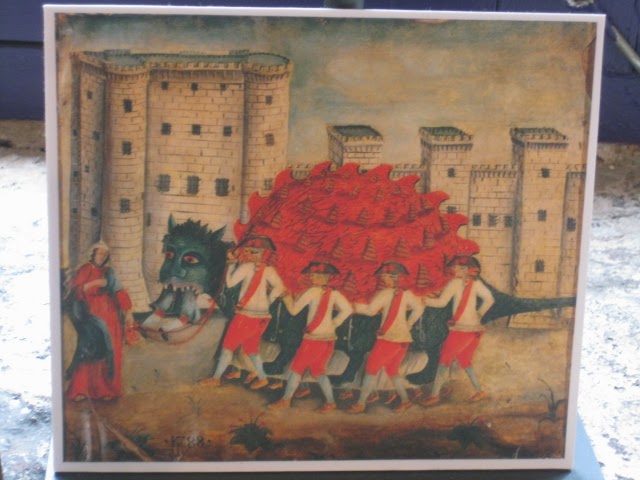
Tarascon (pop. 11,000) and Beaucaire (pop. 13,000) are twin cities connected by a bridge across the Rhone River.  Tarascon is renowned as the home of King Rene's magnificent castle (completed in 1449) and the Tarasque river monster, tamed by St Martha.  Beaucaire also has a ruined castle and a colorful canal full of pleasure boats.

Here are a few pictures.